


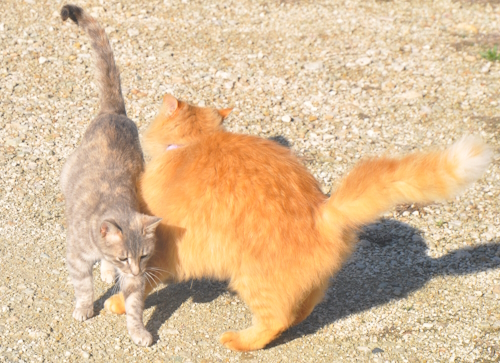
There is a challenge to taming a wild creature and earning its trust. Not forcing domestication, but patiently building a bridge between wildness and companionship. This past autumn, I found myself engaged in exactly that kind of work—six weeks of consistent effort to tame two half-grown feral kittens so they could find a forever home with my niece in the country.
What started as a simple favor evolved into a masterclass in patience, strategy, animal behavior, and the humbling reminder that even the best-laid plans can go sideways in a heartbeat. Or more accurately, in the span of a cat’s panicked leap. If you have read my earlier piece about our journey with indoor animals, you already know this homestead has been a revolving door of creatures great and small—each one teaching us something new.
The Request: A Birthday Party and Two Wild Kittens
In August, we were invited to my nephew’s sixth birthday party. It was during this celebration that another brother’s daughter, Katrina, asked if we had any kittens available. Teva had posted on Facebook during the summer that we had an abundance of kittens. This is one of those homesteading realities that nobody warns you about: if you have an intact female barn cat, you will have kittens…and more kittens.
I told Katrina there were still two kittens at large, and I would begin working in earnest to tame them down. What I did not mention was just how wild these particular kittens were. They were about four months old and very, very wild. In fact, if either cat saw you looking their way, they would dart like a shot from a smoking gun. And talking was completely out of the question.
According to feline behavior research, the critical socialization period for kittens is between 2 and 7 weeks of age. During this window, positive human contact significantly impacts their future temperament and adaptability. After this period, socialization becomes progressively more difficult. At four months old, these kittens were well past that ideal window, having spent their formative weeks hiding under equipment and viewing humans as potential threats. But I was determined. And I had made a promise. So, I began the process of earning their trust.
The Strategy: Consistency, Patience, and Strategic Feeding
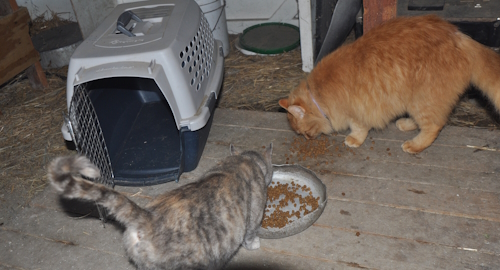
I began feeding consistently at the same time every day, calling the cats I knew would come: Misty, their mama, who is very affectionate, and Timmy, our extremely large, friendly orange boy. I would call them and talk with them and pet them, and the two wild ones took this in from their hiding place in the back of the shed under the old baler.
However, they would not come eat until I went to the milking stall. After I left to milk our cow, I would talk and give some milk to the adult cats, and the little ones would hurry to the pan to lap up what was left. They were hungry enough to emerge, but only when they felt absolutely safe—which meant no humans in sight.
Safe Distance
Here is an interesting fact about feral cat behavior: truly feral cats—those with no positive human contact during their socialization period—will typically maintain a flight distance of at least 10–15 feet from humans. They view people as predators, not providers. Semi-feral cats, like my two kittens who had observed positive human-cat interactions from a distance, fall somewhere in between. They have the capacity to become socialized but require significant patience and consistent positive reinforcement.
I did not feed them at night because I wanted them to get used to being at breakfast. This is a practical application of operant conditioning: if food reliably appears at a specific time in a specific location, animals will adjust their behavior to be present for that reward. Slowly, bit by bit, they began hovering closer to the food pan while I was there.
I would stroke the adult cats, murmuring softly to all of them, and Misty and Timmy would purr and rub against my leg. The kittens watched wide-eyed from their safe distance, observing that nothing bad happened to the cats who accepted human touch. This is called social learning, and it is powerful. Young animals learn what is safe and dangerous by watching older, experienced members of their group.
Meet Blackie and Sissy
I named them Blackie and Sister—Sissy, for short. Sissy was similar in coloring to her mama, gray with flecks of orange and white. Blackie was solid black with yellow-green eyes that seemed to glow.
The Progress: Six Weeks of Small Victories
After about two weeks, I was able to feed them, and they would stay at the pan while I was present, though still out of reach. This felt like a major milestone. They were no longer fleeing at my approach, which meant their perception of me had shifted from predator to neutral presence who brings food.
After six weeks of consistent work, I was finally able to pet Sissy and even pick her up a couple of times. Each touch was slow and gentle, always giving her the option to retreat. She began to lift her tail when I stroked her back, which told me she was beginning to enjoy human contact.
Blackie was a little shyer. While he did not mind being petted every once in a while, he was not yet comfortable with being touched as an ongoing routine. He tolerated touch sometimes, which was quite different from Sissy’s cat behavior.
The Carrier Problem
I had placed the pet carrier next to the food pan a week in advance so the kittens would be used to it sitting there. Desensitization works: make the scary thing part of the normal landscape so it loses its threat value. By the time I needed to use it, the carrier was just another unremarkable object in their environment.
Even the day before the planned transfer, Blackie was skittish and not wanting me to pet him. I felt a twinge of concern. Had I pushed too hard too fast? We were to take the cats to Katrina’s place in the country, but since her son was not feeling well, the plan was put on hold for several days, which gave me more time to work with them. But honestly, I was not sure a few more days would make much difference.
Managing barn animals requires this same kind of patient persistence, whether you are working with cats, chickens, or dairy cows. If you are just starting out with livestock, my guide on how to start your laying hen flock walks through the same slow-and-steady principles that apply here—consistency and routine are everything.
The Capture: A Prayer and Quick Hands
Finally, the big day arrived. Teva had the day off work and agreed to come with me for the 90-minute drive north. First, I needed to get two semi-feral cats into a carrier, which is easier said than done.
I knew both Sissy and Blackie were going to be scared, and I would only have a few seconds once I grabbed them by the nape of the neck to get them into the carrier. I also knew I would have to get ahold of both of them at the same time. If I captured one and attempted to come back for the other, the second one would disappear for days.
I fed them and was talking with them in my usual soothing tone. I took a big breath as I was stroking Sissy at the food pan; said a quick prayer; and grabbed Blackie with one hand, held Sissy down with the other, and then pushed them both into the carrier, fastening the door as fast as I could.
The Carrier Holds – Barely
The hullabaloo and banging that followed made me think the cats might just spring themselves out. The carrier has a weak bottom hinge, worn with age, and we have had cats escape before. Here is an interesting fact about cat escape artistry: cats are remarkably strong for their size, and a panicked one in a confined space can produce enough pressure to damage a worn latch.
I dragged the carrier across the dirt floor of the shed to the truck, carefully holding it to prevent any sudden movements that might give them leverage to escape. Then, I lifted it to the truck bed and shut the tailgate. I exhaled a deep breath. The biggest hurdle was over.
The Trip: Longer Than First Anticipated
Instead of meeting Katrina at the family farm where my oldest brother now lives (since Dad passed last year), Teva and I traveled the extra miles to her house. It was a pleasant drive through rural Kansas, the kind of journey that reminds you why simple living ideas often involve trading convenience for beauty and connection.
After about 90 minutes, we arrived at Katrina’s place—a lovely property with ample space for animals, gardens, and the kind of country life that nourishes the soul. This is one of the benefits of homestead living I explored recently—where unexpected harvests, surprise pumpkins, and unplanned gardens teach the most valuable lessons of all.
Katrina gave us the grand tour. I had not been in the house since they had remodeled, and the transformation was impressive. Fresh paint, new flooring, and thoughtful updates that honored the home’s character while improving functionality. We admired their work and caught up on family news. It reminded me of how a few intentional updates—much like the strategies I share in my piece on home organization one step at a time—can completely transform a space without needing a full renovation.
Then it was time for the main event: transferring two semi-feral cats from my carrier to hers.
The Escape Attempt: When Plans Go Awry
I warned Katrina that the cats were not yet tame, especially Blackie. I opened the tailgate and set both carriers next to each other—hers and mine. We needed to transfer them without giving either cat an opportunity to bolt.
I put my cloth garden gloves on—one of those country home organizing hacks where you keep work gloves in multiple locations because you never know when you will need hand protection. I pulled Sissy out first. She was relatively calm, perhaps recognizing my scent and voice. I passed her to Katrina, who held her and petted her before placing her in the carrier.
Blackie Makes His Move
Again warned Katrina that Blackie was more skittish and might react unpredictably. I pulled him out. He was quiet, but I think he was still in shock from the earlier capture and the truck ride.
Katrina wanted to love on him and thought he was so cute—his glossy black fur and enormous eyes—a perfect little cat face. She felt him tense like a coiled spring and started to put him into the cage, but it was too late. He was making his escape, and the razor-sharp claws came out.
Blackie jumped to the tailgate. I grabbed for him, but with the gloves, I could not get a good grip on his neck. The fabric was too thick. I grabbed for him again and held him by the tail. This did not go over well.
Here is an important fact about cat body language and anatomy: a cat’s tail contains 19–23 vertebrae, about 10% of all the bones in their body. It is not a handle. Grabbing a cat by the tail is painful for the animal and can cause serious injury. In the heat of the moment, I was desperate to prevent his escape.
Blackie began biting and clawing with the fury of a wild thing fighting for its life. I was able to hold his body down against the truck while his teeth sank into my finger. The pain was sharp and immediate, but I could not let go. If he escaped, they would never find him. A feral cat loose in unfamiliar territory will disappear completely.
I finally got a good grip on the scruff of his neck, triggering the same reflex their mothers use to carry them. Katrina opened the carrier door, and I shoved him in with Sissy. We secured the latch.
The Aftermath: Purple Finger and Bandages

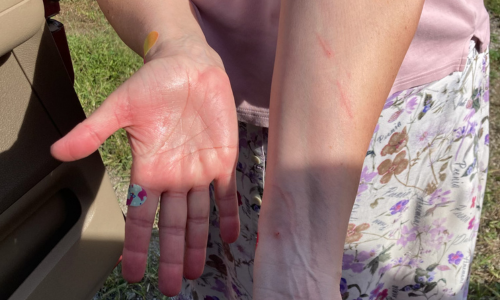
I looked down at my hands. I was thankful I had my gloves on, but even so, the damage was considerable. My finger was turning purple where his teeth had connected. Several of the scratches were deep enough to draw blood, dark red lines welling up on my forearms. There was a deep claw mark in my palm where he had gotten through the glove fabric.
After we had said goodbye and were walking to the truck, I turned back and asked if I could wash my hands. I have heard so many stories about people getting serious infections from cat wounds. Cat bite infections are no joke—approximately 50–80% of cat bites become infected, compared to only 5–15% of dog bites. Cat teeth are like hypodermic needles, creating deep puncture wounds that seal over quickly, trapping bacteria deep in tissue. This can cause rapid onset of painful swelling, redness, and, in some cases, hospitalization.
I washed with hot water and lots of soap, scrubbing thoroughly. I had to apologize to Katrina for emptying her foaming soap dispenser. She laughed and said she would rather have me use all her soap than risk infection.
She had antibiotic ointment and an entire “arsenal” of bandages. I had my choice. So, I chose a red with white polka dots, a llama, and a brightly striped bandage to help protect the most serious wounds. If you are going to get injured, you might as well look festive while healing.
The Return: Backroads and Memories
Teva and I drove the backroads home, and I reminisced, pointing out a few places along the way. There is something refreshing about traveling familiar routes, seeing the landscape of your childhood, and noting what has changed and what remains.
We even stopped by the house my brother, Carl, had rented for 13 years. Katrina would have been in high school when they moved out. The landlord’s son and family moved in. To my surprise, it was gone. Nothing was left but the foundation, concrete corners marking where rooms had been, where life had happened.

I asked Carl what happened. Did it get torn down? He said about four years after they had left, there had been a fire, and it burned to the ground, probably due to electrical issues. It had been an enormous old house with beautiful woodwork and character that modern construction rarely achieves. Gone unexpectedly in a ball of flames.
We stopped by the family farm, and the old sentinel pear tree is still standing. I wrote about this tree last year in “The Pear Tree: A Tribute to My Father,” how it witnessed generations of our family working the land. It was loaded again this year with fruit. When it turns cold, the pears will be ripe and ready to pick, continuing a tradition that stretches back before my birth.
Lessons from Two Different Tales
This experience—six weeks of patient taming, one moment of panic, and a handful of wounds—taught me several things about homestead animal choices and the work of building trust.
Lesson One: Timing Matters
The critical socialization period for kittens exists for a reason. While it is possible to tame older feral cats, the effort required increases exponentially with age. For homesteading for beginners, considering barn cats, early handling of kittens is not optional—it is essential for their future welfare and adoptability.
Lesson Two: Consistency Builds Trust
Showing up at the same time, with the same routine, speaking in the same tone—this consistency communicated safety to those wild kittens. They learned that I was predictable, that my presence meant food and gentle touch, not danger. This principle applies far beyond cat-taming: consistency is the foundation of all animal training and relationship-building. It is also the backbone of a well-run home. The same mindset I bring to feeding schedules for the cats is the same one I apply when I am planning meals or organizing the kitchen—and if you are working on that side of homestead life, my post on making perfect vanilla yogurt without a yogurt maker is a great low-pressure starting point.
Lesson Three: Progress Is Not Linear
Even after six weeks of work, Blackie was still unpredictable. He might tolerate petting one day and flee the next. This is normal. Fear and trust exist on a spectrum, not a simple binary. Some animals require months or even years to fully relax around humans.
Lesson Four: Have an Exit Strategy (and Protective Equipment)
I should have had thicker gloves; I should have had a towel ready to wrap panicky cats. I could have even practiced the transfer procedure with stuffed animals first, thinking through every step and potential complication. Good intentions do not prevent injuries—preparation and proper equipment do. This also applies to organizing homestead workspaces. Keeping gloves, first aid kits, and tools exactly where you need them is just as important as any other home organization strategy.
The Broader Picture: Finding Home
This story is titled “Two Different Tales” because it is actually about more than cat-wrangling. It is about different kinds of homecoming.
The kittens found a physical home with my niece—a barn, reliable food, and safety from predators and harsh weather. But they also found something more: the possibility of trust, the slow transformation from wild things to companion animals. My finger healed completely within two weeks. The scratches left no permanent scars.
Teva and I found a different kind of home on that drive—the home of memory and connection. We visited places that shaped us, mourned what had been lost (a house consumed by flames), and celebrated what endures (a pear tree still bearing fruit).
This is what simple living ideas ultimately mean to me: not minimalism or voluntary poverty, but connection to place, to family, to animals, and to land. It is about showing up consistently, doing hard things with patience, accepting that progress comes slowly, and finding meaning in the work itself.
If you’re thinking about how to make your homestead space work harder and feel more intentional—inside and out—you might also enjoy my post on how to create beautiful DIY table centerpieces, where I explore how small, thoughtful touches transform everyday spaces into something that feels truly like home.